
Build a smart starter toolkit with 10 power tools you will actually use, plus buying tips, accessories, and safety basics for new homeowners.
home improvement and DIY
Table Saw vs. Circular Saw: Which Should You Buy First?

Marcus Hayes
Marcus Hayes is a lifelong DIY enthusiast and former residential carpenter who has spent the last decade renovating his 1970s fixer-upper. Through Tinksmith, he shares his hands-on experience to help fellow homeowners tackle repairs, choose the right tools, and build spaces they love without breaking the bank.
Published October 17, 2026
Updated October 17, 2026
If you are staring at your tool budget wondering whether your first “big” saw should be a table saw or a circular saw, you are in good company. I have owned both while renovating my own very 1970s, very “what were they thinking” fixer-upper, and here is the honest takeaway: for many beginners, a circular saw is the better first buy, then a table saw once you know you will actually use it.
There are a few situations where flipping that order makes perfect sense (cabinets, built-ins, lots of identical rips). Let’s break it down like a neighbor leaning over the fence, coffee in hand, trying not to step on the kid’s sidewalk chalk.
The quick answer
- Buy a circular saw first if you are doing general home DIY, framing, decks, fences, sheathing, subfloor, drywall backers, or breaking down plywood. It is cheaper, portable, and can do a shocking amount with the right blade and a straightedge.
- Buy a table saw first if your projects are mostly furniture, built-ins, shelving, cabinets, and you need lots of repeatable, accurate rip cuts. It is faster for production-style work, but costs more, takes space, and demands more respect in the safety department.
What each saw is best at
Table saw strengths
A table saw is basically a stationary cutting station where you push the wood through the blade. Its superpower is repeatability.
- Ripping boards and sheet goods accurately (cutting with the grain). Set the fence once, make the same cut ten times.
- Cabinet and furniture work: shelves, face frames, panels, trim parts, drawer components.
- Joinery options if you add jigs or a dado stack (where legal and compatible): rabbets, dados, tenons. Note: many jobsite saws do not accept dado stacks, or they require specific throat plates and arbor length.
- Cleaner, straighter cuts once tuned and paired with a good blade.
Circular saw strengths
A circular saw is a handheld workhorse. You bring the saw to the material, which is perfect for real-world homeowner jobs.
- Breaking down plywood without wrestling a full sheet onto a table saw.
- Framing and outdoor projects: 2x lumber, decks, fences, shed builds.
- Jobsite flexibility: cut in the driveway, basement, backyard, or right where the project lives.
- Great bang for the buck: you can get cutting today without building a dedicated shop around it.

Accuracy
Most people assume a table saw is automatically “more accurate,” and a circular saw is automatically “rough.” The truth is a little more polite and a little more annoying.
Table saw accuracy
- Potentially the most accurate, especially for repeated rip cuts.
- Accuracy depends on fence quality, blade quality, alignment, and whether the saw is stable.
- Cheaper benchtop table saws can be accurate, but the fence can be finicky. A wiggly fence is like measuring with a rubber ruler.
Circular saw accuracy
- Freehand cuts are only as straight as your technique, but you can get very straight results using a guide.
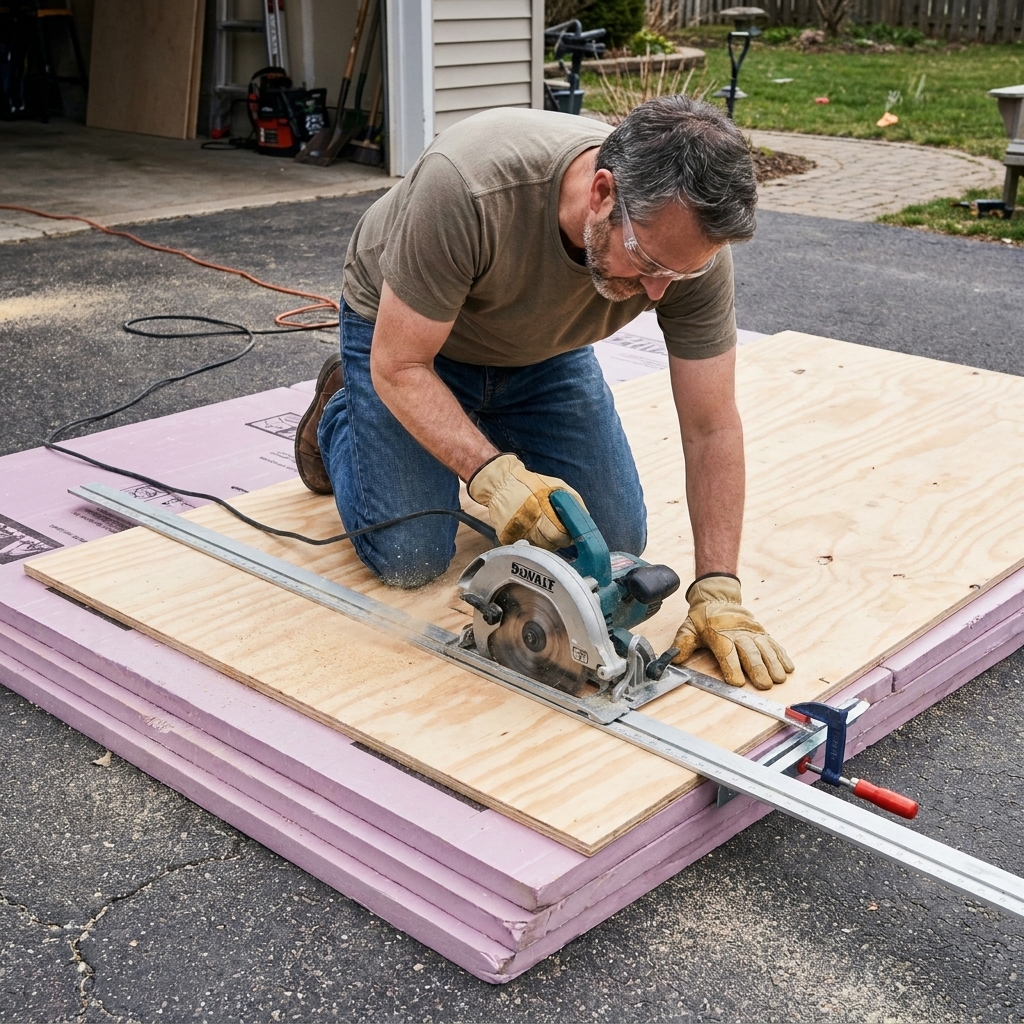
- A $20 straightedge and a couple clamps can turn a circular saw into a plywood cutting machine.
- For cabinet-level precision, a circular saw can get close, but it usually takes more setup time and careful measuring.
My real-world rule: If you need perfectly identical pieces all day, table saw. If you need “fits well after a little sanding and common sense,” circular saw with a guide.
Safety
Both tools can hurt you. The bigger difference is how quickly a mistake can turn serious, and how predictable your setup is.
Table saw safety reality
- A table saw can cause severe injury in a split second, especially with kickback (when the workpiece gets launched back at you) or hand-to-blade contact.
- Modern safety features help a lot: riving knife, blade guard, anti-kickback pawls, and a solid fence.
- Safe technique matters: push sticks, proper stance, never reaching over the blade, and not freehanding cuts.
Circular saw safety reality
- Kickback is possible, but the built-in lower blade guard and the fact that you are not feeding stock past a fixed blade often makes it feel more manageable for beginners.
- That said, circular saw injuries are still very common. The riskiest moments are sloppy support (pinching and binding), starting or ending a cut where the guard hangs up, and letting the offcut drop and grab the blade.
- Most common issues are binding, cutting into what you did not mean to cut, and poor support under the workpiece. Cord management matters too. Keep cords and hoses out of the cut path.
- With a circular saw, you can often set up the cut so your hands are naturally farther from the blade.
Beginner-friendly safety takeaway: A circular saw is not “safe,” but it is often an easier first saw to operate safely if you respect it, support your work, and keep the guard working freely.
PPE baseline: eye and hearing protection every time. If you are cutting MDF or doing lots of sheet goods, add a dust mask or respirator. For corded tools outside, use a GFCI-protected outlet and a proper outdoor-rated extension cord.

Space, dust, and noise
Space
- Table saw: wants dedicated space plus infeed and outfeed room. Even a small table saw becomes a “furniture rearrangement tool” when you need to rip an 8-foot board.
- Circular saw: stores on a shelf. You can cut outside on sawhorses or foam insulation.
Dust
- Table saw: can be excellent with dust collection, but only if you have a shop vac or collector and the saw shrouds well.
- Circular saw: tends to throw dust. Cutting outdoors helps. Indoors, a vacuum attachment can reduce the mess, but it is rarely perfect.
Noise
Both are loud. Wear hearing protection. Your future self will thank you when you are not saying “huh?” at every backyard barbecue.
Cost
Circular saw starter budget
- Saw: typically the lowest entry cost, corded or cordless.
- Must-haves: a good blade (more on that below), a speed square, clamps, and either sawhorses or foam insulation to cut on.
- Nice-to-have: a straightedge guide or track-style guide.
Table saw starter budget
- Saw: higher cost, especially if you want a fence that stays square without drama.
- Must-haves: quality blade, push sticks or push blocks, outfeed support, and at least a shop vac.
- Nice-to-have: a crosscut sled, featherboards, better miter gauge, and eventually a dedicated stand or mobile base.
Hidden cost alert: Table saws often lead to “just one more accessory” purchases. Not because you are weak. Because jigs are fun and also because you will want safer, more precise workflows.
Best use cases
Get a circular saw first if you plan to…
- Build a deck, pergola, fence, or shed
- Finish a basement and cut studs, plates, and sheathing
- Replace subfloor or cut plywood for repairs
- Do general household projects where portability matters
- Work outside or in a small garage with limited space
Get a table saw first if you plan to…
- Build cabinets, built-ins, or lots of shelving
- Make furniture where repeatable cuts matter
- Do trim carpentry parts in volume (ripping filler strips, scribing material, etc.)
- Work mostly in a dedicated garage or shop area
- Want joinery capability without jumping straight to a router table

Common scenarios
Apartment or townhouse DIY
Circular saw. You can store it easily and break down materials in a parking spot or on a balcony if allowed. Pair it with a clamp-on straightedge and cut outside whenever possible.
New homeowner doing “everything”
Circular saw first, then reassess after 3 to 6 months of projects. If you keep wishing for faster, repeatable rips, add a table saw later.
Kitchen remodel with cabinet modifications
If you are mostly trimming filler strips, scribe pieces, and cutting panels, a table saw can be a huge advantage. If space or budget is tight, a circular saw plus a good guide can still get you there, just slower.
Building a workbench, then shop furniture
Circular saw first to build the bench and basic shop setup. Then consider a table saw once you have a stable place to put it and you know your workflow.
Planning to build cabinets and built-ins right away
Table saw, provided you can buy one with a decent fence and basic safety features. Cabinet work is where a table saw feels like it is earning rent.
Blades matter
You can make a great saw look bad with a junk blade. And you can make a decent saw look surprisingly good with the right blade.
Circular saw blade basics
- Framing blade (fewer teeth): faster cuts in 2x lumber, rougher finish
- Fine-finish plywood blade (more teeth): cleaner cuts in plywood and trim
- Tip: If you cut plywood a lot, put painter’s tape over the cut line and use a fine blade to reduce tear-out.
Table saw blade basics
- General purpose combination blade is a great start for mixed ripping and crosscutting.
- If you do lots of plywood, a plywood or hi-ATB blade can reduce chipping.
- Keep blades clean. Pitch buildup increases burning and makes the saw feel underpowered.

Circular saw setup tips
This is where beginners can really stretch a budget.
Use a straightedge guide
Clamp a straight board, level, or factory edge track to your plywood and run the saw base against it. Measure your saw’s offset (distance from blade to base edge) once, write it on the saw with a marker, and you will cut straighter with half the stress.
Support the sheet properly
My favorite cheap method is a full sheet of rigid foam insulation on the driveway. Lay the plywood on top, set blade depth just past the material, and cut without worrying about sawhorses pinching the blade.
Mind the shoe and blade depth
- Keep the saw base flat on the work at all times.
- Set blade depth so the teeth clear the bottom of the material by roughly 1/4 inch, or about one tooth below the board. Deeper is not better and can increase binding and kickback risk.
Table saw tips
Prioritize a real riving knife
A riving knife that rises and falls with the blade is one of the best safety upgrades in modern saws. If the saw you are eyeing has outdated guarding or no riving knife, think hard before buying it.
Plan for outfeed support
A table saw without outfeed support is like trying to fold laundry in a hallway. You can do it, but you will regret it. Even a simple outfeed table or roller stand helps.
Learn a few core skills early
- Fence discipline: lock it, confirm it is parallel, do not bump it mid-cut
- Push stick habits: if your hands feel close, they are close
- Kickback prevention: keep stock tight to the fence, do not trap offcuts, and use a splitter or riving knife
- Crosscut basics: use a miter gauge or sled. Do not trap a board between the fence and blade during a crosscut unless you are using a proper stop block setup that avoids binding.
Decision checklist
- Do you need portability? If yes, circular saw.
- Are you cutting full sheets alone? Circular saw is easier and often safer.
- Do you need repeatable rips for cabinets or shelves? Table saw.
- Do you have a dedicated space? If no, circular saw.
- Is your budget tight? Circular saw plus a guide, good blade, and clamps.
- Are you willing to commit to table saw safety learning? If yes, a table saw can be a great first “shop anchor” tool.
FAQ
Can a circular saw replace a table saw?
For many homeowners, yes for a long time. With a straightedge guide, a good blade, and patient measuring, you can handle most sheet goods and framing tasks. Where it struggles is fast, repeatable precision and narrow rips.
Can a table saw replace a circular saw?
Not really. A table saw is fantastic in the shop, but it is awkward for breaking down full sheets solo, and it is not great for trimming something in place where the work already is. Many DIYers end up owning both, just not on day one.
What about a track saw?
A track saw is like a circular saw that went to finishing school. It is excellent for clean, straight sheet-good cuts, especially for cabinets. It also costs more. If your budget allows and you are cabinet-focused without space for a table saw, a track saw can be a smart “first big saw.”
Corded or cordless circular saw?
If you cut a lot at home near outlets, corded is usually cheaper and never runs out of juice mid-cut. If you work outside, on a roof, or away from power, cordless is worth it. Either way, prioritize a good blade and solid baseplate.
What size circular saw should a beginner get?
A 7-1/4 inch saw is the most versatile for home projects and has the widest blade selection. Smaller saws can be lighter, but you may hit depth limits on thicker material.
Should I consider a miter saw instead?
If your projects are mostly 2x lumber and trim cuts (decks, framing, baseboards), a miter saw can be an excellent second tool after a circular saw. It is not a replacement for ripping sheet goods, but it is fast and accurate for crosscuts.
Bottom line
If you want one saw that gets you building right away, fits in a small space, and handles the messy reality of home projects, start with a circular saw and spend a little extra on a good blade and a simple cutting guide.
If you are jumping straight into cabinets, built-ins, or furniture and you have room to set up safely, a table saw can be the better first purchase, as long as you buy one with modern safety features and a fence you can trust.
Either way, the “right” first saw is the one that matches what you will actually build next weekend, not the one that looks coolest on a YouTube thumbnail.